How long will it take you to finish the Patagonman?
I find that a difficult question. I don't have any comparable experiences yet and with every prediction I make I could be completely wrong.
Yet it is also an essential question because of the so-called 'cutoff' times. The cutoffs mark points on the route that I must have passed before a certain time. If I take too long, my race will end there. That's the last thing I want, of course. In this blog I will discuss the feasibility of the cutoffs and how long I think it will take me to finish the Patagonman.
Are the cut-offs achievable?
After I saw the first images of Patagonman, I immediately started looking at the 'cutoff' times. I was of course curious whether these would be feasible for me and to what extent.

Since my 'come back' in 2019 I have already gained some endurance experiences on the basis of which I can estimate whether these cutoffs are within my capabilities. In addition to shorter triathlons and individual swimming, cycling and running events, I did twice a half triathlon in Duisburg and recently a long course weekend. In it you do a triathlon in a weekend. Based on these events, the following times should be feasible under normal circumstances:
3.8 km swim: 1:10 to 1:20 hours
180 km cycling: 6 to 7 hours
42.2 km run: 4 to 5 hours
Total, including bills approx.: 11:30 a.m. to 1:40 p.m.
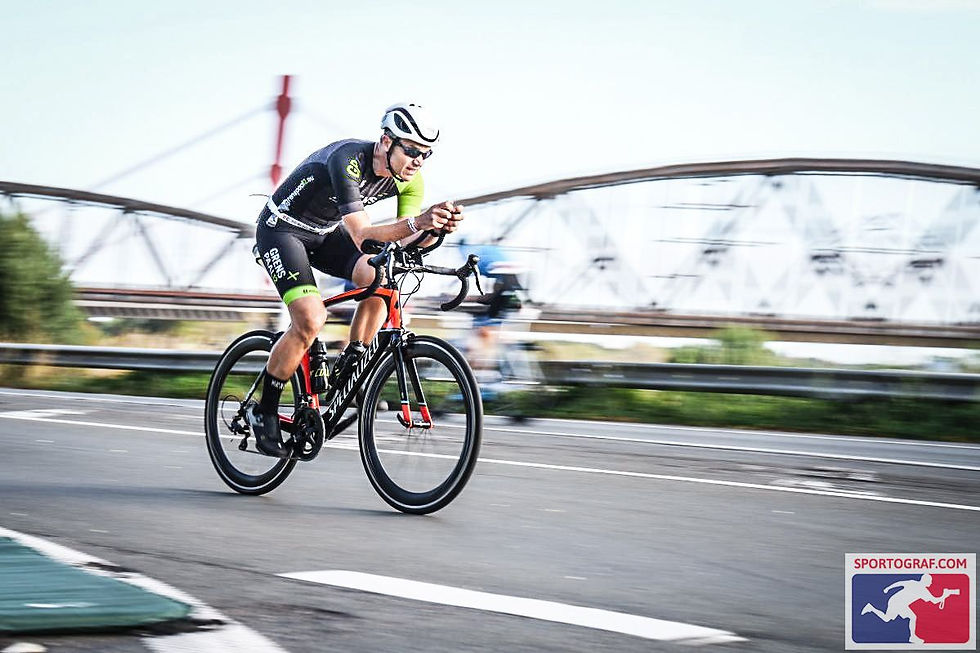
Patagonman is not a normal Ironman.
But the above times are based on times in a 'normal' Ironman and not an extreme triathlon like Patagonman is. In an earlier Blog I described what the Patagonman race looks like. It is a so-called extreme triathlon in which you largely have to arrange your own care for the road. In addition, the conditions such as current, weather and relief are other factors that make it harder and therefore also cost extra time.
Can I easily see where to go in the dark?
For example, I find swimming a challenging part, starting in the dark in an ice-cold fjord. What about the current and the waves? Can I easily see where to go in the dark? Am I not hypothermic? The bike course is uphill for 170 km and how is the wind? And finally the off road marathon with some river crossings, and let's hope I don't get lost...
So I will have to build in some extra margin, and assuming a time of 13:40 under normal conditions I still have more than 3 hours of margin to reach the finish in Puerte Ibáñez. In any case, this margin and the recent events that I have done give me the confidence that the cutoffs should be feasible.
The fourth discipline of the triathlon
And then there is also something like the food and drink that are perhaps the most important success or failure factors in a full distance triathlon. That is why it is often referred to as the fourth discipline. My carbohydrate reserves will be completely depleted during the race, and so have to be replenished. About 12,000 to 13,000 kcal. But more on that another time.
The goal is to finish!
You now understand that it is difficult to predict how long I think it will take. And I can't bet on two horses: finish and then also want to be as fast as possible. If I go too fast I consume too many carbohydrates and electrolytes, which I can no longer replenish during the race. And then I have a DNF after my name; Didn't Finish.
There is no second change during the race
There is no second change during the race. So I have to make a choice in advance and that choice was made quickly for me: I want to finish! So I will have to be careful with my reserves from the start and especially not be allowed to go too fast. I will have to go even slower than I potentially could, as well as keep my nutrition and hydration in order. I'll explain how to do that another time. And then there are all kinds of other dangers lurking that I have no control over. In short, my main goal is and will always be to finish, and I have a maximum of 17 hours for that!



Comments