Racing in the Wild Nature of Sweden
My sporting destination for 2025 was the Swedeman Xtreme triathlon. The race takes place annually around Åre, one of Sweden's largest winter sports resorts and only 300km south of the Arctic Circle. Highlights of this race include swimming across Sweden's largest waterfall at Tännforsen. And one of the toughest marathons in the Xtri World Tour, over the 1440m-high Åreskutan.
Up early
At 3:00 AM, Saskia, my supporter, and I were able to enjoy a simple breakfast with coffee and tea at our hotel in Åre. We athletes left at 4:00 AM by bus for the swim start. Saskia drove our rented Toyota Yaris Cross to the transition zone T1. This was located near the swim exit at the Tännforsen waterfall. With a drop of 37 meters, it's Sweden's highest waterfall. Until the briefing on Friday afternoon, it had been uncertain whether the swim at Tännforsen would go ahead due to the extremely high discharge and current at the waterfall.

Xtri races are self-supported, meaning you need your own support person to provide you with drinks and food along the way and to take your bike away afterward. Often, and this was also the case in Swedeman, there's a section of the Marathon where you need to be alone for safety reasons. And that, too, is the responsibility of the support team. Boy was my support person for previous races in Patagonia and Montenegro. For the Swedeman, Saskia was my support person.
Tännforsen Waterfall
We set off at 5:00 a.m., while two Swedish women and a man in glittering outfits sang live Abba songs to us. Despite it being nighttime, it was broad daylight, and we swam under a clear blue sky toward the first buoy. In one of the photos below, we're looking from the top left to the mouth of the waterfall in the bottom right.
Photos @ArielWojciechowski
My start was unsettled. My goggles were leaking slightly, so I had to stop a few times to put them back on. And because of the cold water, around 13 degrees Celsius (55 degrees Fahrenheit), and even colder towards the waterfall, my mouth felt a bit stiff, and I swallowed a bit more water than I was used to. After a few hundred meters, I was comfortable with my stroke. The sun, the dark but clear water, and the view of the forests and mountains while breathing made me thoroughly enjoy it. It was going to be a long day, so I wanted to conserve my energy and swam at a calm, steady pace. We swam in a straight line to the first buoy. Then left towards the second buoy, and then right towards the waterfall where the swim exit was. When I passed the second buoy, I was surprised how close the waterfall and the swim exit were. Over the past few days, we had already visited the waterfall and witnessed the force of the thundering water up close. A few times, I looked up and enjoyed the waterfall basking in the full sun. To reach the exit, I swam into the outflow, and my plan was to swim slightly with the current, in the wrong direction, to get through as quickly as possible. Then, along the edge, where the countercurrent is weakest, I'd swim back to the exit. I don't know exactly how much I drifted, but after clambering and swimming, I reached the exit, where a man and a woman from the organization helped me out of the water. The first few meters after a long swim are always a bit wobbly.
The climb to the transition zone T1
To reach T1, I had to cover a steep section of about 400m. We'd agreed that Saskia would meet me at the bottom of the exit with a poncho and two stroopwafels so I could make good use of the time. I saw a lot of supporters, but no Saskia. My thoughts drifted back to Patagonman , where Boy had also missed me at the swim exit. I decided to walk up the hill anyway. Running would waste too much energy to gain a few seconds. Halfway up the hill, Saskia came rushing down. She thought I'd already passed her and had therefore gone back up to see if I was in T1 yet. We laughed about it and continued with our plan. She helped me change in the very cramped transition area, and the cycling could begin.
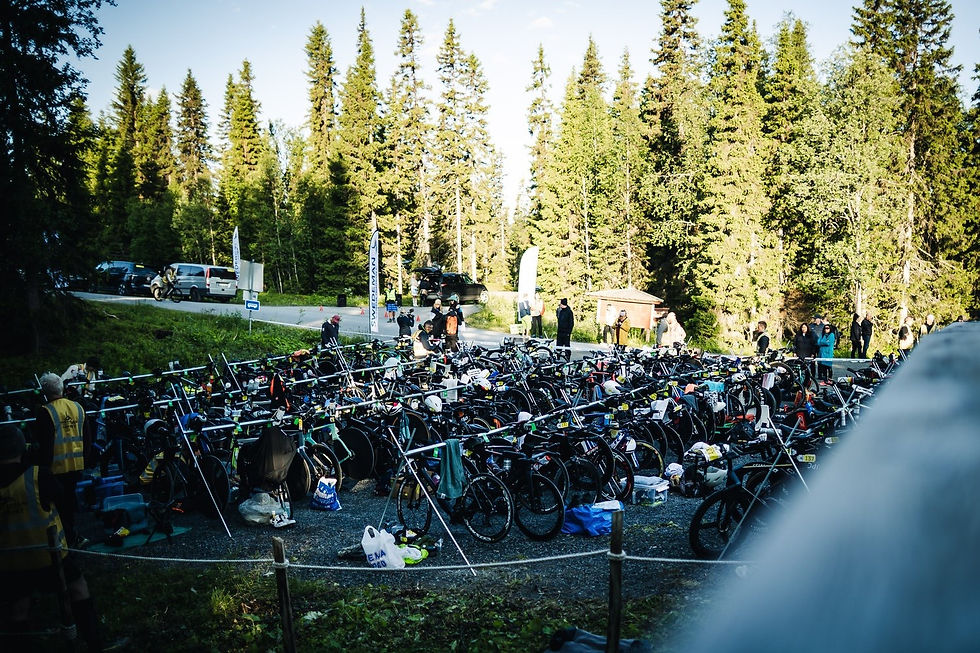
Photos @ArielWojciechowski
205 km of Swedish roads
The bike course at Swedeman is a bit longer than 'normal', 205 instead of 185 km. But it is known as one of the faster courses with good asphalt. With 2000 meters of elevation gain, it's also not extreme for an Xtri. During the pre-ride briefing with Edwin Dasselaar, third overall in 2023 and my coach last year, we assumed a westerly wind and a fast first 60 km. Since car traffic is only allowed to go 60 km/h, Saskia wouldn't have much time to reach the first stop. But an Xtri rarely goes according to plan A, and so I encountered an easterly wind. This resulted in a bit more time for Saskia. We had agreed on at least three resupply stops: at 60, 105, and 170 km. I set off under a still clear blue sky with a pleasant Swedish sun. A tri-suit with shorts and a long-sleeved cycling jersey was a perfect choice and I would wear it throughout the bike ride. The course undulated up and down. No long, steep climbs, so it certainly wouldn't be considered a difficult course. But it was never truly flat either, and combined with the headwind and the extra length, it was quite a challenge.
Photos @ArielWojciechowski
Along the way, there were many forests, beautiful lakes, and panoramic views. The stops went according to plan and were a pleasant change for my back and stomach. A TT bike is fast and definitely an advantage on this course, but it's not comfortable. And with sports nutrition from Precision Fuel and Dextro, I was in good hands this time. But for a change, some peanuts, a local pastry called "Kanel Bulle," a Snickers bar, banana, and cola were very welcome.
The route itself was very clear, with long roads and two left and two right turns. Navigation wasn't really necessary, and I didn't have it with me. After stop 3, it was a right turn and then back to Äre towards T2, transition zone 2 for the transition from cycling to running. Supporters had been urged via the Swedeman app group to get to T2 on time due to a traffic jam on the E14 caused by roadworks. We agreed not to make any more stops before T2, and I brought enough food. I had a tailwind for the last stretch, and at 40 km/h, I flew past the traffic jam. It was very long. With only 30 km to go, I prepared myself to be faster at T2 than Saskia. During the last 20 km, the weather changed; it started to rain, so I still got soaked. Sas still hadn't passed, so I didn't have my rain gear handy, but it didn't make much difference. I started the last 2 km that I had scouted out a few days before, the only real climb with an average gradient of 6%.
The back office
Along the way, Saskia would receive regular support from Jacques, our remote control center. Through the life tracker, as long as there was a signal, and other modern gadgets, the athlete's and support person's positions were closely monitored and relayed. Thanks, Jacques!
Coffee with cinnamon bun
Once at T2, it turned out Saskia wasn't there yet. This was a problem for several athletes, and as compensation, we were offered a cup of coffee and a Kanel Bulle. A local delicacy that I really enjoyed. Feeling a bit chilled, I enjoyed the coffee and the Kanel Bulle. Relaxed, I glanced at the summit of Åreskutan and saw that it had disappeared into the clouds. The wait felt like an eternity, but I calmly let it happen. I think I ended up waiting 5 or 10 minutes before I saw a hurried Saskia running towards me.

To change clothes dry, we huddled together under the transition area's only party tent. With numb hands, I pulled off my wet cycling jersey while Saskia replaced my wet socks with dry ones. I decided to dress warmly, a lesson learned from my previous Xtri in Montenegro, BlackLake (link). The Run was about to begin.
On to the Åreskutan
The Swedeman Marathon is known as one of the toughest on the Xtri calendar. Those who make the cutoff—you must have reached T2a at 28km by 6:30 PM—continue with the high course over the summit of Äreskutan (1440m). This is done with your support runner, as for safety reasons, you are not allowed to cross the summit alone. If you don't make the cutoff, the low course towards Åre follows. Our goal was the high course. Saskia had run the Zugspitse trail in Garmisch-Partenkirchen less than a month earlier on June 13th, a 30km trail with 1500 meters of elevation gain, so she was in good shape.

After T2, the climb quickly became steep. I'd discussed with Edwin the idea of hiking the first climb and not wasting too much energy. After a 4.5 km climb, I arrived at a plateau against the flanks of Åreskutan. It was a very boggy and muddy trail with several stream crossings, meltwater, and patches of snow. You automatically try to keep your feet dry as long as possible, but that was soon over. With mud up to my knees, I decided not to take any unnecessary risks and hike where I didn't have a good view of the next landing. Then came a long descent along a forest path. At km 14, there was an aid station where I refilled my bottles. Then, the route diverted to a dirt road for 4 km. Here I met Saskia again for the first time. The road undulated up and down, and I realized that scraping across the boggy plateau had worn me out, despite the hiking. I decided to hike uphill and replenish my energy. When I turned back into the forest, Saskia headed to T2a to get ready to run the last stretch with me. What followed was a 10 km singletrack up and down through a dense forest. It was pretty damn cool to be able to run through that. Since I wasn't sure I'd make the cutoff, I tried to run as much as possible.
I finally reached T2a well in time, where Saskia was already waiting for me. There I also met Joost, whom we'd met a few days earlier. Joost was Patrick's support guy, and together they were part of "The Best of Best," a club of seven from Best, easily recognizable by their homemade Swedeman hoodies.
Left: Joost and I at T2a Right: Joost and Patrick at the finish
I had already understood that the high course over the summit of Åreskutan was unfortunately closed due to the poor weather conditions. Cold, strong winds, snow, and poor visibility. Of course, I had already looked up and seen that it wasn't ideal. So I was okay with it; safety comes first! The first eight athletes had been sent down the high course. I spoke to the support runner for the eighth athlete the next day, and it was clear that it was the right decision. The descent, in particular, was impractical due to the poor visibility, not to mention the cold.
Photos @TimMalmborg
With the pressure off, we set off leisurely from T2a. My plan beforehand was to finish before 8:00 PM, and we had plenty of time for that. Several bystanders had told us it would be all downhill. Well, that was disappointing. But otherwise, it was a beautiful trail along a treacherous rooty path on the southern slopes of Åreskutan. The last 2 km were quite steep downhill, and we decided to accelerate a bit more and overtook several couples. We finished around 7:45 PM, tired but satisfied, at the central square in Åre.
Still to the Top
Two days after the race, the weather had improved, and we finally made our way to the top of Åreskutan. We took the cable car most of the way, though. This way, we were still able to enjoy this unique and beautiful mountain and its 360-degree views.

Every time I am amazed by the human spirit.
How at one moment you ask yourself WHY?
Why am I doing this, I'm not made for this.
And not even 24 hours later you feel the inspiration and motivation
for a next adventure and
you are already making plans again.
So to be continued!
Greetings Bart


Comments